It is a non-trivial thing, you see, to step off the mat and into the archives. Most people, and they mean well, they really do, assume that if you are a martial artist, your world is defined by the physical perimeter of the dojo. They see the sweat, the bows, the repetitive drills, and they think, “Ah, here is a man who teaches people how to kick.” But that is a surface-level analysis, and a shallow one at that.
When I announced I was writing a historical narrative on the Battle of Hastings, the collective response was a confused, “Why?” As if the study of combat and the study of history were somehow mutually exclusive. But they aren’t. Not even close.
If you think martial arts is about learning how to throw a punch, you’ve missed the point entirely. It’s about voluntary confrontation with chaos. The real curriculum isn’t “technique”; it’s the development of the soul. It’s the capacity to remain upright and articulate while you are being pressed to your absolute limit.
History is the same thing, just scaled up across time. When I look at 1066, I’m not looking at a list of dates. I’m looking at the ultimate testing ground of the human spirit.
For decades, I’ve watched students struggle with the exact same dragons that were present at the Battle of Hastings: the paralyzing grip of fear, the temptation to break ranks when the shield wall is failing, and the crushing weight of self-doubt.
The Mat gave me a vocabulary of movement.
History gave me a vocabulary of meaning.
Writing this book wasn’t a “pivot.” It was an attempt to take the truths I’ve seen on the mat, the high-stakes reality of human struggle, and map them onto the foundational stories of our civilization.
The Battle of Hastings is the archetypal moment where one world ends and another begins. It is the story of Harold Godwinson and William the Conqueror, two men forced to contend with the absolute unpredictability of fate.
Harold had to march his men across the entirety of England, fighting one existential threat at Stamford Bridge only to turn around and face another at Senlac Hill. That is the martial arts spirit manifest in history: the refusal to quit even when the odds are, for all intents and purposes, zero. It is the story of what happens when the shield wall finally breaks, and you have to decide who you are in the wreckage.
Have you ever known someone like William, who bent the entire world to his will? Or someone like Harold, who did everything that duty demanded, and still failed? Odds are you have. The stories are real, and very human.
We live in this strange, postmodern delusion that we can just invent ourselves out of thin air. It’s a lie. A dangerous one. Martial arts teaches you to honor your lineage, to recognize that you are the tip of a very long, very ancient spear.
If you want to know why you value courage, or why you believe in the rule of law, you have to go back to the blood and the mud of 1066. You have to understand the catastrophe that birthed the English-speaking world. History provides the roots that keep you from being blown over by the first ideological wind that comes along.
We are currently drowning in a culture of passive nihilism. It’s easy to sit on the sidelines and criticize; it’s much harder to step onto the field and take responsibility for the outcome.
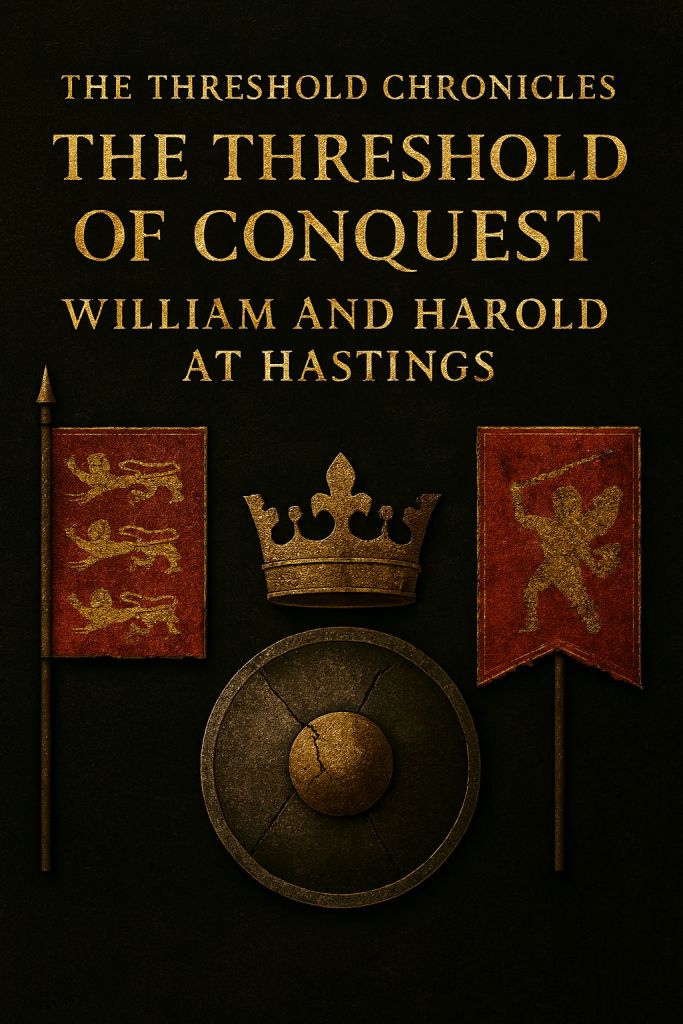
The men who stood on that ridge at Hastings, on both sides, understood that their actions mattered. They weren’t spectators. They were the architects of a new reality. I wrote the Threshold of Conquest because we need to remember what it looks like when people take ownership of their destiny.
Whether you are defending yourself in a dark alley or defending the values of your civilization, the principle is the same: Stand up straight, shoulders back, and face the chaos. That is what the mat taught me, and that is what the history of 1066 demands of us.
 Wallace Smedley