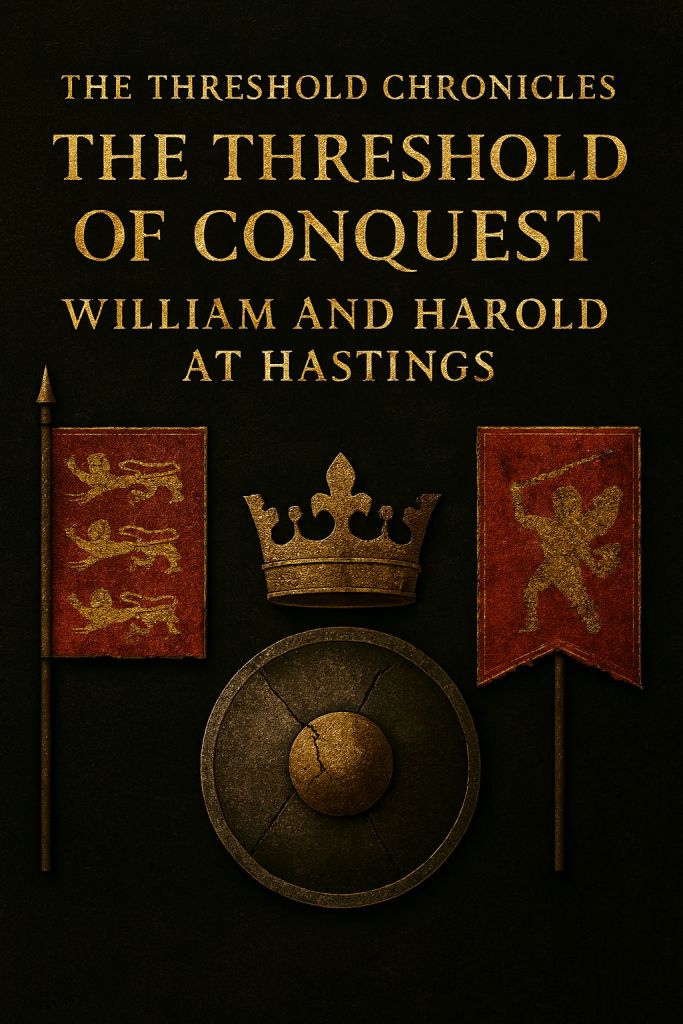
There are moments in history when the entire future hangs by a thread so thin it’s almost embarrassing to call it a plan. The Battle of Hastings is one of those moments.
We often talk about 1066 as if it were inevitable; Norman knights, Saxon shields, a king struck down, a new order rising. But inevitability is a story we tell ourselves to feel safe. The truth is far more unsettling.
The world we live in; our language, our laws, our political assumptions, even the cadence of our daily speech, exists because of a chain of contingencies so fragile that a single misstep in a muddy field in Sussex could have shattered them.
If Harold had held the ridge.
If William’s horse had stumbled.
If an arrow had flown a few inches wide.
If a rumor of retreat had not spread at the exact wrong moment.
A different England would have emerged.
And with it, a different West.
We forget how thin the social contract really is. We forget that the systems we rely on; justice, governance, identity, are not natural laws. They are agreements. They are stories we choose to believe together. And like all stories, they can be rewritten in an afternoon.
Hastings reminds us that civilizations don’t fall only when they are weak. They fall when the wrong person slips, when the wrong rumor spreads, when the wrong decision is made in the fog of uncertainty. They fall because human beings; flawed, hopeful, frightened, ambitious, are the ones holding the line.
And yet, that fragility is not a cause for despair. It’s a call to attention.
Because if the world can be reshaped by a single day, then the world can be reshaped again, by the choices we make now, by the stories we choose to carry forward, by the identities we decide to inhabit.
I’ve spent a great deal of time immersed in that hinge‑moment of 1066, trying to understand not just what happened, but what it meant, for the people who lived it, and for the world that inherited its consequences. The deeper I go, the more I realize that Hastings is not just a battle. It’s a mirror.
It shows us how precarious our certainties are.
It shows us how quickly a culture can be unmade.
It shows us how much depends on the character of those who stand at the threshold.
And it invites us, quietly, insistently, to consider our own thresholds today.
What are the fragile agreements we take for granted?
What contingencies are shaping our future right now, unnoticed?
What stories are we choosing to live inside?
Hastings is a reminder that history is not a straight line. It is a series of narrow passes, each guarded by people who rarely realize how much rests on their shoulders.
We are living through our own narrow pass.
And the choices we make, individually and collectively, will echo far longer than we imagine.
I invite you to walk this field with me.
 Wallace Smedley